H111 is a common delivery temper for aluminum-magnesium (corrosion-resistant) aluminum sheets in industrial orders. However, many procurement and process engineers have a vague understanding of its performance characteristics, often confusing it with the other tempers like O-temper (fully annealed/soft) or H32 (half-hard) tempers, which can lead to incorrect material selection and reduced production efficiency. As a manufacturer and supplier with years of experience exporting aluminum sheet plates, we draw upon our production and customer service expertise to break down the processing nature, performance parameters, and suitable applications of H111 aluminum sheets, providing a clear reference for material selection.
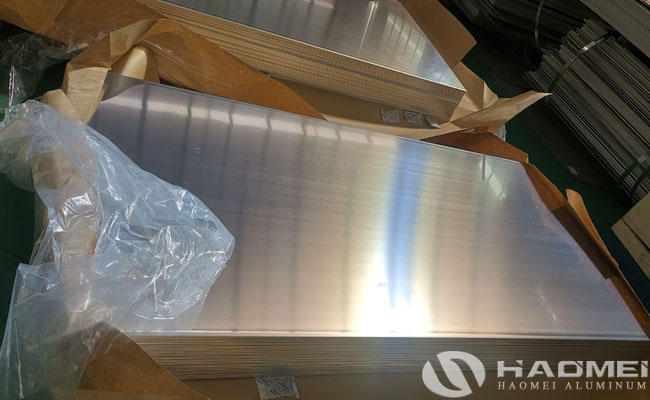
By standard definition, H111 represents a “lightly strain-hardened” temper for wrought aluminum alloys. According to ASTM B209 and EN 485 standards, the production process involves: cold-rolling the plate, followed by full recrystallization annealing to eliminate all rolling-induced strain hardening, and finally applying a small amount of cold work (2%–8% deformation) to achieve slight hardening. Consequently, the overall level of internal residual stress is among the lowest of all strain-hardened tempers. The core objective of this process design is to compensate for the low strength associated with fully annealed (O-temper) sheets while retaining high ductility.
Taking the most widely circulated 5052-H111, 5083 H111, 5086 H111 and 5754 H111 aluminum plates as examples, their key mechanical parameters meet international standards: tensile strength consistently ranges from 205 to 260 MPa, proof stress (yield strength) is ≥110 MPa, elongation after fracture is ≥16%, and Brinell hardness is approximately 45–60 HB. For a given thickness, the yield strength of this temper is about 15% higher than that of the same alloy in the O-temper, offering superior resistance to collapse after bending. Compared to the same alloy in the H32 half-hard temper, the yield strength is approximately 30% lower while elongation is 30% higher, resulting in greater versatility for bending and welding processes. Regarding dimensional precision, the tolerance for standard-thickness plates is controlled within ±0.05 mm, and surface flatness is ≤0.3 mm/m, allowing for direct integration into automated welding production lines.
The core value of H111 aluminum plate lies in welded structural applications. Its low residual stress characteristics ensure uniform deformation release during the welding thermal cycle; actual measurements show that post-welding overall planar deformation is more than 60% lower than that of H24 semi-hard plates of the same thickness. This eliminates the need for subsequent manual straightening, significantly boosting mass production efficiency. Furthermore, its resistance to atmospheric and salt-spray corrosion is comparable to that of O-temper aluminum sheets of the same alloy, withstanding neutral salt spray tests for over 720 hours. Currently, h111 aluminium plate is widely used in products such as commercial vehicle fuel tanks, chassis skid plates, marine interior bulkheads, large ventilation ducts, and welded frames for outdoor equipment.
Based on our customer service experience, many commercial vehicle component manufacturers previously used H24 semi-hard aluminum plates for fuel tanks, resulting in a post-welding deformation non-conformance rate of nearly 8% and necessitating dedicated straightening stations. After switching to H111 aluminum plates, post-welding deformation remained within drawing tolerances; the overall capacity of a single welding production line increased by approximately 12%, while total processing costs dropped by 15%. As a professional aluminum sheet manufacturer, we offer H111 aluminium plates in mainstream corrosion-resistant alloys such as 5052, 5754, and 5083, with thicknesses ranging from 1.0 mm to 12 mm. Production strictly adheres to international standards, with material certification provided for every batch, and we offer precise selection support tailored to specific customer welding processes and structural requirements.